· AI Agents · 3 min read
The Autonomous Enterprise: Orchestrating Multi-Agent Workflows in 2026
The Autonomous Enterprise: Orchestrating Multi-Agent Workflows in 2026
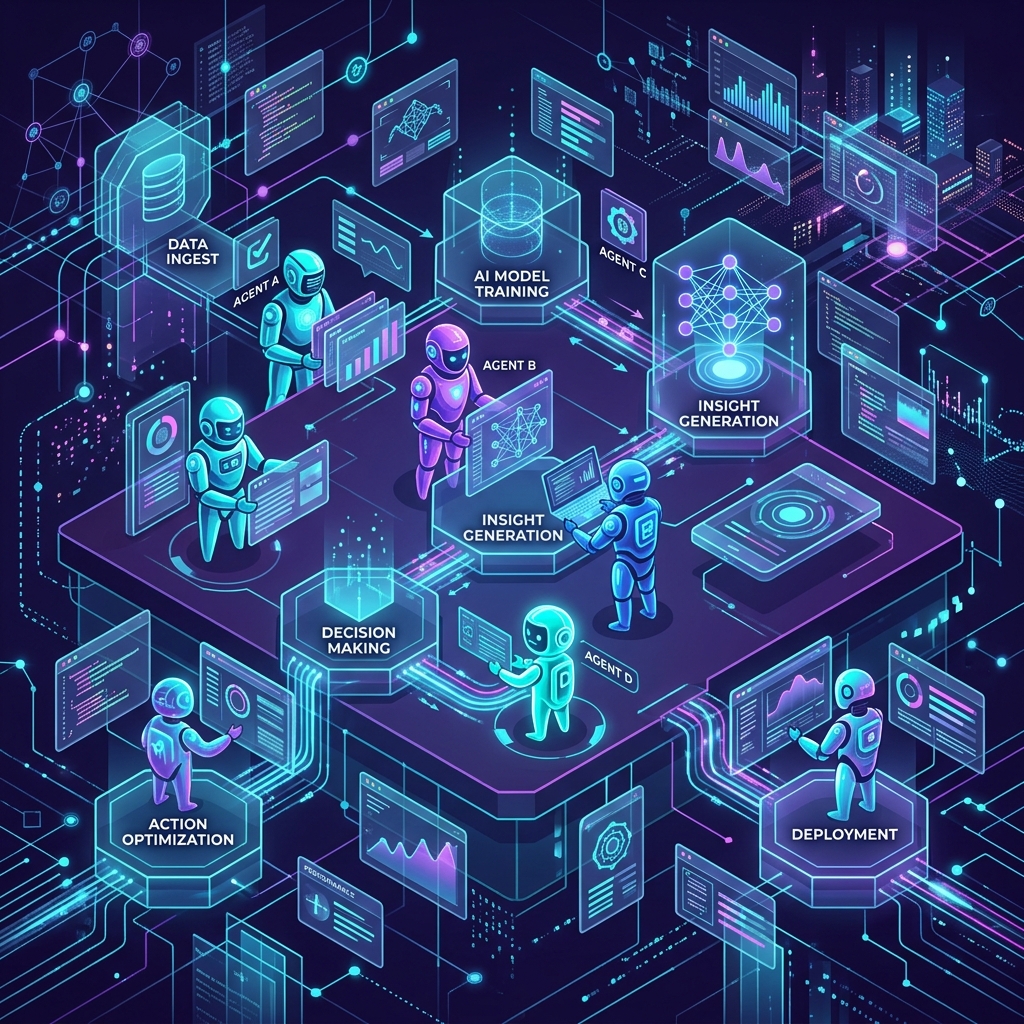
If 2024 was the year of experimental AI wrappers, 2026 is officially the year of the Autonomous Enterprise. We are no longer discussing single-prompt chatbots helping employees draft emails. Today, forward-thinking organizations are orchestrating entire networks of specialized, autonomous AI agents that communicate, delegate, and execute complex workflows without human intervention.
Let’s explore how this shift is reshaping system architectures, operational efficiency, and the future of work.
What is a Multi-Agent Network?
In a multi-agent system, instead of relying on one massive, generalized Large Language Model (LLM) to handle everything, developers deploy multiple smaller, specialized agents. Each agent is configured with distinct tools, prompt parameters, and execution permissions.
For instance, an autonomous customer-retention workflow might feature:
- The Sentiment Analyzer: Scans inbound support emails for frustration, key terms, and account value.
- The Data Fetcher: Interacts securely with the company’s internal CRM to pull recent usage metrics and historical support tickets.
- The Strategist: Considers the usage metrics and sentiment score to formulate a custom concession offer (e.g., a discount, bonus credits, or a direct call scheduler).
- The Communicator: Generates, tests, and refines the personalized response email, passing it to a final automated sender once verified.
Moving Beyond Simple APIs: Agent-to-Agent (A2A) Protocols
The true magic happens when agents communicate directly using structured communication protocols. By utilizing formats like JSON-schema messaging or semantic query layers, agents can negotiate tasks.
For example, if the Strategist needs information on product billing details but doesn’t have database access, it issues a request to the Billing Agent:
{
  "request_id": "req-998a1",
  "from_agent": "Strategist",
  "to_agent": "Billing",
  "action": "get_billing_status",
  "parameters": {
    "customer_id": "cust-505"
  }
}
This decoupling ensures strict boundary lines, enhanced security, and modular scaling. If a billing API changes, only the Billing Agent needs a code update, keeping the rest of the multi-agent fleet operational.
Key Benefits of Multi-Agent Orchestration
1. Resilience and Scalability
If a single LLM call fails, the entire transaction is typically dropped. In a multi-agent workflow, agents can catch errors, retry failing sub-tasks, or request help from alternative agents, mirroring a real business team.
2. Guardrails and Security
By assigning minimal permissions to individual agents, you protect sensitive enterprise data. A marketing-copy agent has no business touching customer databases, while a database-query agent lacks the authority to write public marketing copy.
3. Lower Inference Costs
Running a massive model for simple tasks is highly inefficient. Multi-agent networks let you assign lightweight models (e.g., 8B parameters) for routing and parsing, and only call heavy frontier models (e.g., Gemini 1.5 Pro) for complex strategic decisions.
Navigating the Challenges
Building an autonomous enterprise is not without obstacles:
- Loop Prevention: Ensuring agents do not get caught in infinite query-response loops.
- Traceability: Implementing comprehensive tracing systems (like LangSmith or Phoenix) to monitor agent conversations and trace errors.
- Human-in-the-Loop (HITL): Correctly positioning human checkpoints for high-risk decisions, such as processing refunds or approving code deployments.
As we move forward, companies that successfully deploy structured agent environments will outpace their competitors in delivery speeds, operational efficiency, and customer satisfaction. The age of manual operations is fading; the future belongs to autonomous coordination.