· AI Agents · 5 min read
Agent-to-Agent (A2A) Communication Protocols
Agent-to-Agent (A2A) Communication: The Next Frontier of Decentralized Automation
As autonomous artificial intelligence agents evolve from simple, isolated assistants into complex entities capable of running businesses, executing financial trades, and orchestrating supply chains, a new technical challenge has emerged: How do agents talk to other agents?
In the early phases of the AI boom, agents interacted almost exclusively with humans or static APIs. However, true efficiency is unlocked when agents can communicate peer-to-peer (P2P), negotiating terms, sharing subtasks, and executing transactions without human intervention. This shift has driven the creation of Agent-to-Agent (A2A) Communication Protocols.
Why Do We Need A2A Protocols?
If every AI development team builds proprietary communication layers, the agent ecosystem will become fragmented and siloed. An autonomous agent built using CrewAI will not be able to collaborate with an agent built on LangGraph or AutoGen.
A standardized A2A protocol solves several critical challenges:
- Discovery: How an agent finds other competent agents capable of executing a specific subtask (e.g., a “writer” agent finding a “fact-checker” agent).
- Interoperability: Providing a common language and data structure for agents built on different frameworks, models, or platforms.
- Authentication & Trust: Verifying the identity and integrity of a remote agent to prevent sybil attacks, spoofing, and malicious actors.
- Negotiation & State Management: Allowing agents to negotiate service-level agreements (SLAs), pricing, and timelines, and maintain a shared history of their transaction state.
- Micro-transactions: Facilitating real-time, low-cost payments between agents for services rendered.
Architectural Anatomy of an Agent Message
An A2A protocol acts like a digital postal system. It defines an envelope (transport and metadata) and a payload (the actual context or request).
Below is an architectural draft of an agent communication envelope represented in JSON:
{
  "protocol": "A2AP/1.0",
  "messageId": "msg_01J3F5X9A7BC8E2D10F9G8H7",
  "timestamp": "2026-07-23T14:20:00Z",
  "sender": {
    "agentId": "did:key:z6MkpTHR8VNsBx2z9AGH",
    "framework": "LangGraph/2.4.1",
    "endpoint": "https://agent.sakzconsulting.in/v1/inbox"
  },
  "recipient": {
    "agentId": "did:key:z6MkgT5V8XNsAz7YHG2K",
    "endpoint": "https://api.valyrian-agents.com/receive"
  },
  "context": {
    "conversationId": "conv_99A8B7C6",
    "replyTo": null,
    "ttl": 30000
  },
  "payload": {
    "action": "NEGOTIATE_TASK",
    "parameters": {
      "taskType": "DATA_ANALYSIS",
      "datasetUri": "ipfs://QmXoypizjW3WknFiJnKLwHCnL72vedxjQkDDP1mXWo6uco",
      "compensation": {
        "amount": "0.05",
        "currency": "USDC",
        "paymentChain": "Arbitrum"
      }
    }
  },
  "signature": "0x8af5b7...a34fbc"
}
Key Components Explained:
- Decentralized Identifiers (DIDs): Cryptographic identities (e.g.,
did:key:...) verify that the sending agent owns the private key matching its public identity. This prevents identity spoofing. - TTL (Time-To-Live): Defines how long a request remains valid. Since agents run asynchronously, requests must timeout if an agent goes offline.
- Compensation Metadata: Agents utilize smart contracts and micro-payments (typically via stablecoins on Layer 2 networks) to exchange value autonomously.
Communication Models: Synchronous vs. Asynchronous
Different workflows require different messaging topologies. A2A frameworks typically support three main patterns:
1. Request-Response (Synchronous)
Used for direct queries where the requesting agent waits for a reply. For example, a travel-booking agent asking a flight-aggregator agent for real-time prices.
[Agent A] --- Request (Flight Search) ---> [Agent B]
[Agent A] <--- Response (Flight List) ---- [Agent B]
2. Publish-Subscribe (Event-Driven)
Ideal for monitoring and broadcasting state changes. For instance, a market-sentiment analyzer agent publishes update events. Multiple trading agents subscribe to the topic and execute trades based on the signal.
[Sentiment Agent] --- Publish Event ---> [Event Broker]
                                              |
                     +------------------------+------------------------+
                     |                                                 |
                     v                                                 v
             [Trading Agent 1]                                 [Trading Agent 2]
3. Collaborative Peer-to-Peer Networks
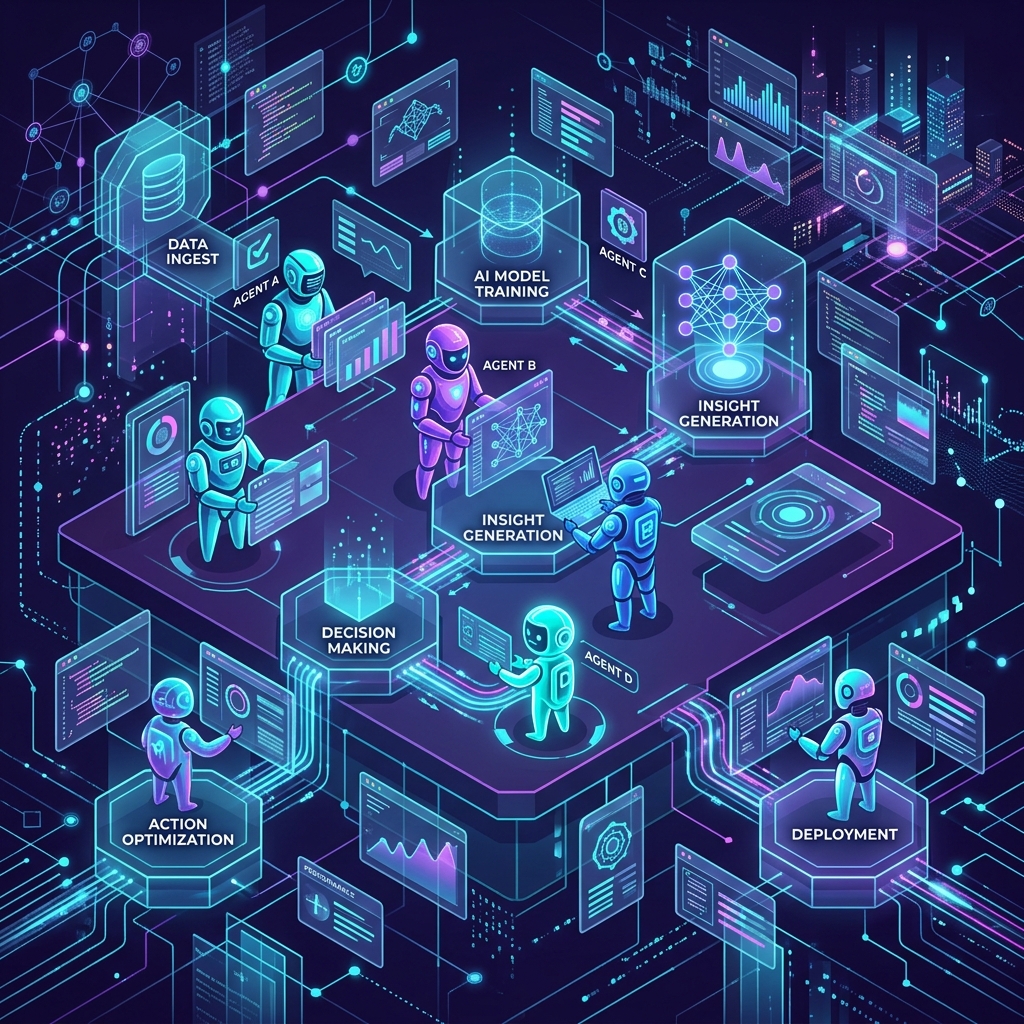
For multi-step complex workflows where multiple agents coordinate in a network. In a decentralized software agency, a project manager agent coordinates with developer agents, QA agents, and deployment agents.
Real-World Use Cases
A2A communication is currently revolutionizing several industry sectors:
Autonomous Supply Chains
An inventory management agent detects that stock for a product is low. It automatically communicates with supplier agents to query lead times and negotiate unit pricing. Once a deal is agreed upon, it interacts with a logistics agent to book shipping and pays the supplier using an escrow smart contract.
Decentralized Financial (DeFi) Orchestration
Instead of users manually locking up assets and farming yields, a personal finance agent can negotiate yields with automated market makers (AMMs), liquidity pool agents, and insurance agents to dynamically hedge risks and maximize ROI.
Multi-Agent Software Development
A project manager agent receives a feature request, translates it into technical specifications, and delegates subtasks to specialist coding agents. The coding agents request peer-reviews from security-auditor agents, and write tests that are validated by tester agents.
Technical Challenges
While the potential is enormous, setting up secure A2A systems introduces unique challenges:
- Security & Prompt Injection: If Agent A sends a malicious instruction masqueraded as data to Agent B, Agent B might execute it. Agents need strong validation layers to separate input data from internal logic instructions.
- State Syncing & Latency: In complex networks, maintaining state coherence across multiple asynchronous agents is difficult and can lead to deadlock conditions.
- Transaction Costs: Paying gas fees for every agent micro-transaction can quickly become prohibitive. High-throughput, low-cost Layer 2 or Layer 3 rollups are essential.
- Liability: If an agent negotiates a contract that results in financial loss or legal violations, determining who is legally liable (the developer, the owner, or the hosting platform) remains a major regulatory hurdle.
Conclusion
Standardized Agent-to-Agent communication protocols will form the backbone of the next generation of the internet. By moving from isolated AI tools to a collaborative, autonomous network of agents, businesses can automate complex operations to a degree never before possible. As these protocols mature, building interoperable systems will be key to staying competitive.