· AI Agents · 5 min read
Agentic RAG: The Next Evolution of Information Retrieval
Agentic RAG: The Next Evolution of Information Retrieval
For the past couple of years, Retrieval-Augmented Generation (RAG) has been the go-to architecture for enterprise AI applications. By connecting large language models (LLMs) to private vector databases, businesses successfully reduced model hallucinations and grounded AI responses in factual, domain-specific data.
However, standard RAG systems suffer from structural limitations. They are static, linear, and struggle with complex queries. To overcome these limits, a new paradigm has taken over: Agentic RAG.
By introducing reasoning loops, multi-step planning, and self-correction, Agentic RAG turns basic search pipelines into autonomous research engines.
The Limits of Standard (Naïve) RAG
Standard RAG follows a simple, rigid pipeline:
- Receive user query.
- Convert query to vector embedding.
- Retrieve Top-K matching documents from a vector database.
- Pass the query and retrieved documents to the LLM.
- Generate the final answer.
While effective for simple lookups, this approach fails in more demanding scenarios:
- No Source Verification: If the vector database returns irrelevant document chunks (due to bad semantic matching), the LLM will still try to write an answer using them, leading to plausible-sounding hallucinations.
- Single-Shot Limitation: Standard RAG cannot break down complex queries. If a user asks, “Compare our Q2 sales in Europe with Q2 sales in Asia and list the key drivers for the difference,” standard RAG tries to answer in one go rather than retrieving Europe data, then Asia data, then analyzing the difference.
- Inability to Deal with Ambiguity: If the user query is vague, standard RAG cannot ask clarifying questions or refine its search parameters dynamically.
What Makes RAG “Agentic”?
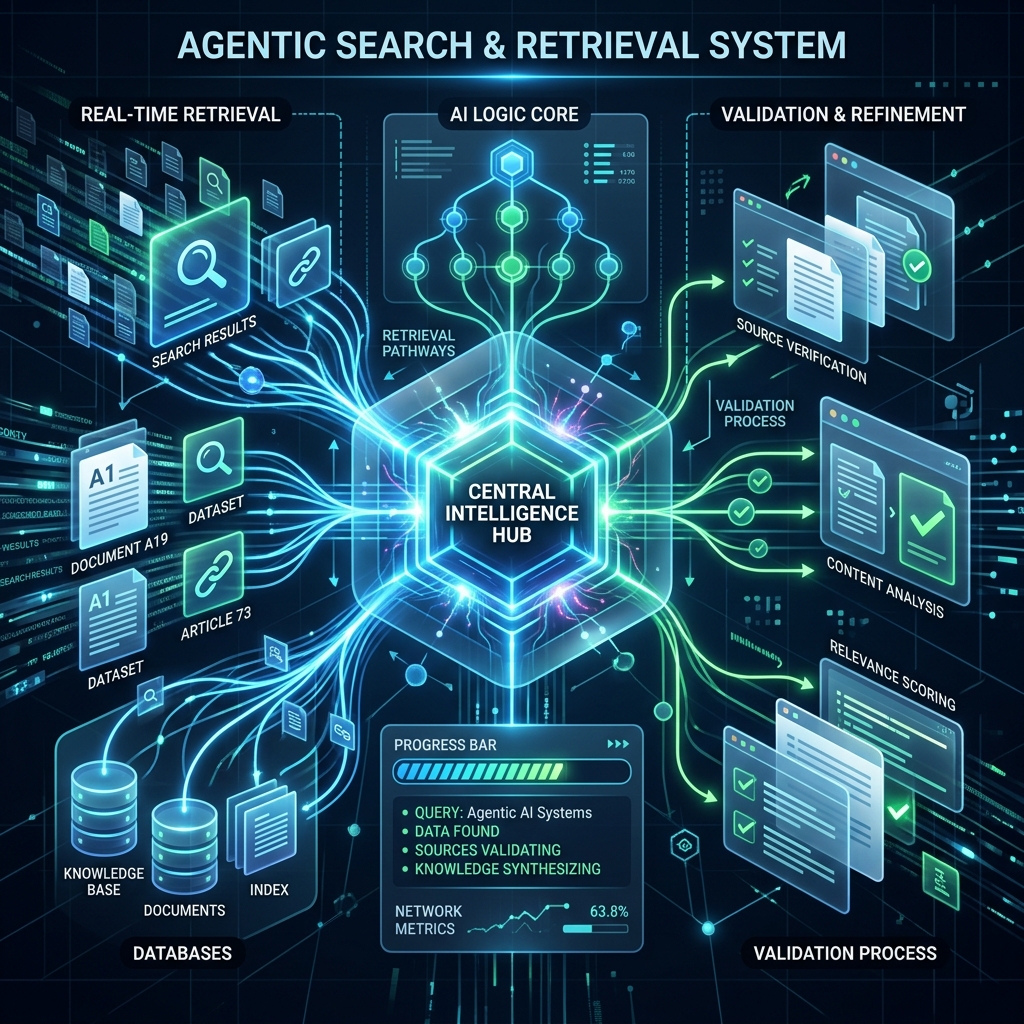
Agentic RAG transforms retrieval from a pipeline into a closed-loop feedback system. Instead of blindly feeding search results to the generator, an Agentic RAG system employs an autonomous loop controlled by the LLM.
                  +-----------------------+
                  |      User Query       |
                  +-----------------------+
                              |
                              v
                  +-----------------------+
                  |   Agent Planner &     | <-------------------------+
                  |   Query Formulator    |                           |
                  +-----------------------+                           |
                              |                                       |
                              v                                       |
                  +-----------------------+                           |
                  |  Multi-Source Search  |                           |
                  | (Vector, Web, SQL)    |                           |
                  +-----------------------+                           |
                              |                                       |
                              v                                       |
                  +-----------------------+                           | Re-try /
                  | Document Evaluator /  | -- Irrelevant / Empty -->+ Refine
                  | Relevance Checker     |                           | Search
                  +-----------------------+                           |
                              |                                       |
                        Relevant Docs                                 |
                              v                                       |
                  +-----------------------+                           |
                  |     Hallucination     | -- Verification Failed --+
                  |        Grader         |
                  +-----------------------+
                              |
                       Validated Data
                              v
                  +-----------------------+
                  |    Final Response     |
                  +-----------------------+
Key Capabilities:
- Routing: The agent analyzes the query and decides which database to query (e.g., Vector DB for text docs, SQL Database for structured transactions, or Web Search for real-time news).
- Query Reformulation: The agent generates multiple search queries, synonyms, and subqueries to pull the best content.
- Relevance Grading: The agent reads the retrieved chunks and grades them (e.g., Relevant / Irrelevant). Irrelevant chunks are discarded.
- Self-Correction: If the graded chunks are insufficient to answer the query, the agent adjusts its search strategy and searches again.
- Answer Verification: Once the final response is prepared, the agent checks it against the source documents to ensure no ungrounded claims are made.
Popular Agentic RAG Design Patterns
Several architectural frameworks have emerged to standardize Agentic RAG:
1. Corrective RAG (CRAG)
CRAG adds a lightweight evaluator before generation. If the retrieved documents fall below a confidence threshold, the agent automatically pivots to alternative sources (like Google Search or Wikipedia API) to supplement the context before answering.
2. Self-RAG
Self-RAG is an end-to-end framework where the LLM is trained to output special reflection tokens. These tokens trigger actions like “retrieve new documents,” “evaluate chunk relevance,” or “check for hallucination” dynamically during generation.
3. Plan-and-Execute RAG
For complex, multi-part questions, the agent creates a sequential plan of steps. It executes each step (which may involve multiple searches and document reads), gathers the intermediary outputs, synthesizes them, and produces the final comparative response.
Coding an Agentic Loop: An Example
Here is a simplified Python conceptual loop showing how an agent evaluates retrieved documents and self-corrects:
class AgenticRAG:
    def __init__(self, vector_db, llm_client):
        self.vector_db = vector_db
        self.llm = llm_client

    def retrieve_and_verify(self, query, max_retries=3):
        search_query = query
        for attempt in range(max_retries):
            print(f"Searching for: '{search_query}' (Attempt {attempt + 1})")
            docs = self.vector_db.similarity_search(search_query, k=4)

            # Step 1: Grade relevance
            relevant_docs = []
            for doc in docs:
                is_relevant = self.llm.check_relevance(doc, query)
                if is_relevant:
                    relevant_docs.append(doc)

            # Step 2: Evaluate if we have enough info
            if len(relevant_docs) >= 2:
                # We have enough validated data to answer
                return self.llm.generate_answer(relevant_docs, query)

            # Step 3: Self-correct and formulate a new query
            print("Insufficient data. Reformulating query...")
            search_query = self.llm.reformulate_query(query, search_query)

        return "I apologize, but I could not retrieve sufficient validated context to answer your question."
Business Impact
By adopting Agentic RAG, organizations can deploy AI systems that are significantly more reliable:
- Reduced Hallucinations: Because answers are strictly verified against source documents, the rate of hallucinations drops to near zero, making AI suitable for high-risk domains like legal, medical, and financial analysis.
- Complex Document Audits: Financial analyst agents can compare years of SEC filings, highlighting trends and anomalies by systematically walking through sections page-by-page.
- Intelligent Support Systems: Customer support agents can query internal wikis, check order databases, retrieve shipping policies, and synthesize a complete, verified answer to complex customer requests without human intervention.
Conclusion
Agentic RAG is moving search from static lookup to active reasoning. The ability of an AI system to analyze what it knows, recognize what it does not, and actively seek out correct information is a massive leap forward. For businesses building on enterprise knowledge bases, upgrading to an agentic architecture is the single best way to ensure trust and reliability.